
Project updates
All lanes (except the centre bus lanes) were reopened at the end of 2025.
Work in 2026 will include completing the centre transit stations, traffic & light pole energizing, construction of the multi-use path, landscaping, final asphalt paving, painting line markings and red bus lane only paint.
Lane restrictions along Wellington Road are expected through Fall 2026.
Starting Monday, March 16, 2026 (weather permitting), early work will begin on Phase 2, the final stage of the Wellington Gateway project.
Phase 2 will be completed in two parts, starting with Phase 2A, which covers Wellington Road from Wilkins Street to Base Line Road East.
To prepare for construction, lane restrictions will be in place at the intersections of Commissioners and Wellington and Waterman and Wellington to allow for the installation of temporary traffic signals.
Full construction of Phase 2A is scheduled to begin in early April 2026.
About this project
The Wellington Gateway is one of three rapid transit projects moving forward in London, designed to improve transit frequency and reliability along this key corridor. The project will widen approximately 6 km of Wellington Road/Street between Downtown and Highway 401 to add continuous, dedicated transit-only lanes.
Once complete, the project will strengthen connections to neighbouring municipalities and improve access to south London’s employment areas, including a transit hub at White Oaks Mall and a proposed park-and-ride near Highway 401. Construction of the remaining phases is expected between 2024 and 2027.
The Wellington Gateway will improve safety for all road users, add multi-use paths, introduce transit signal priority and new traffic systems, enhance streetscapes, and upgrade aging underground infrastructure. The project is one of 10 transit and transit-supportive initiatives funded by the Government of Canada and the Province of Ontario, alongside the Downtown Loop and East London Link projects.
Centre-median
A centre median is the strip of land or barrier that runs down the middle of a road, separating traffic going in opposite directions. It can be raised, painted, landscaped, or include a barrier, and on rapid transit routes, it often provides a dedicated lane for buses in the centre of the road.
Rapid transit needs a centre median to keep buses safe, frequent, and reliable, whether they run in the curb lane or the middle of the road. Because of this, left turns will only be allowed at traffic lights, and driveways or smaller streets will become right-in/right-out only.
Businesses along Wellington Road may need to change how vehicles enter, exit, or make deliveries.
Construction phasing
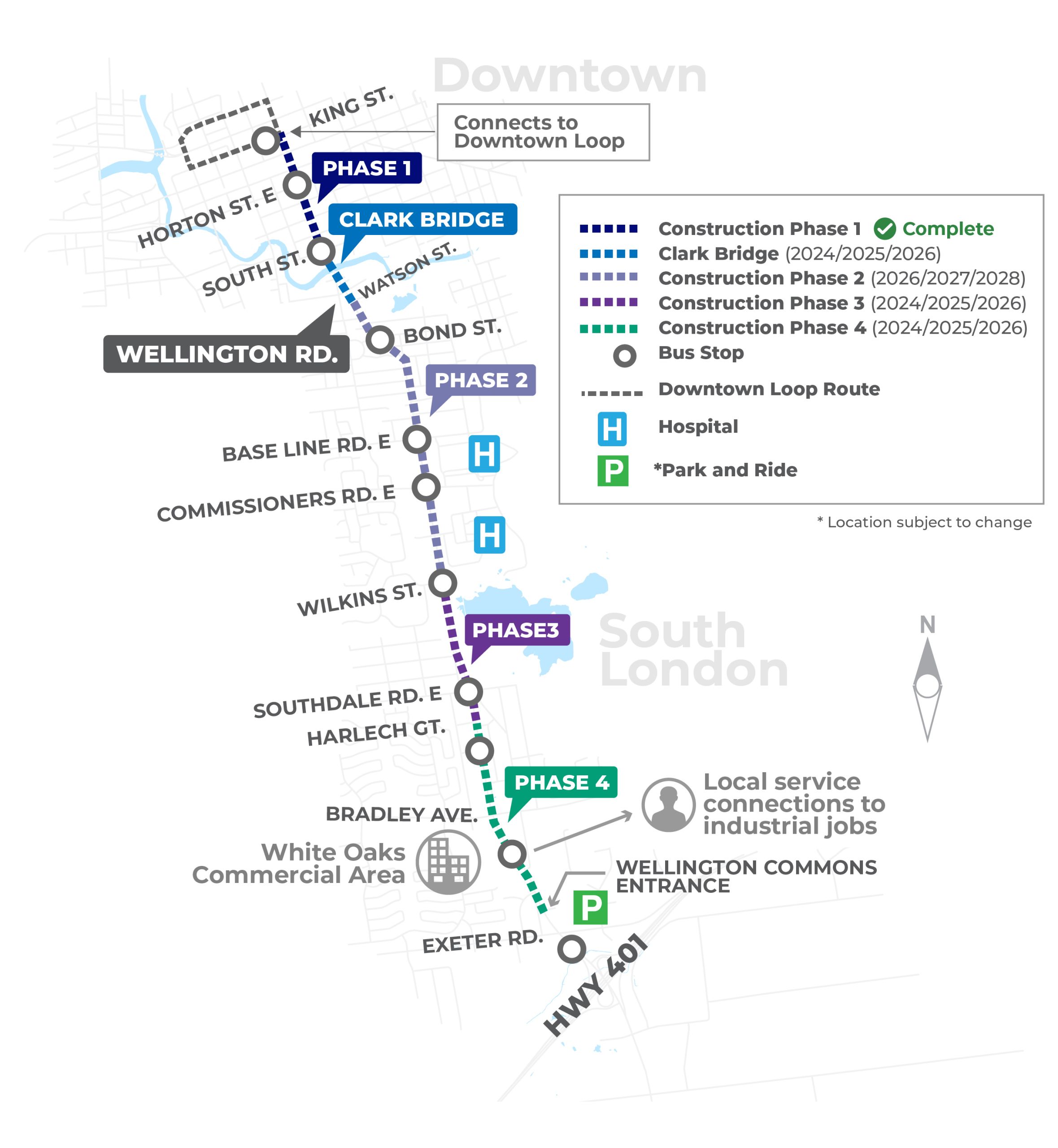
Above: The map shows the planned construction phases for the Wellington Gateway project, including approximate timelines and completed phases
Wellington Gateway Phasing
Below is an overview of the construction phasing for the Wellington Gateway project. Please note that the phases are not completed in numerical order; sequencing is based on construction logistics, traffic management, and project priorities rather than phase number.
Each phase includes detailed information about project limits, anticipated impacts, and key milestones to help residents, businesses, and road users understand what to expect as construction progresses.
Phase 2 of the Wellington Gateway project includes the reconstruction of Wellington Road between Watson Street and Wilkins Street.
Construction is to be split into two segments: Phase 2A from Wilkins Street to Base Line Road E. and Phase 2B from Base Line Road E. to Watson Street.
Construction is planned to begin in 2026, and continue through 2027, with cleanup work in 2028, subject to property and approvals.
Looking ahead to Phase 2 construction in 2026, the City of London held a public engagement period from May 28 to June 11, 2025, allowing residents and businesses to review near-final designs and learn more about the project.
Phase 2A Pre-construction webinar
A pre-construction webinar was hosted for Phase 2A. The presentation provided an overview of Phase 2, including upcoming construction impacts for Phase 2A. Watch the presentation here. To view the presentation slides, click here.
Design webinar
A virtual meeting was hosted on Wednesday, May 28, 2025, presenting the project design, anticipated construction timeline, and impact mitigation measures. Watch the webinar here.
About Phase 2
Phase 2 of the Wellington Gateway will:
- Widen and reconstruct Wellington Road/Street to add dedicated centre-running rapid transit lanes
- Add new rapid transit stops at Bond Street, Baseline Road East, and Commissioners Road East
- Replace or install a concrete median in the centre of the road
- Improve safety for all road users, including realigning the S-curve south of Bond Street
- Add multi-use active transportation paths along the east side of Wellington Road
- Install a new signalized intersection at Bond Street and Whetter Street
- Introduce traffic systems with transit signal priority, sensors, and video cameras to improve traffic flow
- Enhance streetscapes and upgrade underground infrastructure, including sewers and watermains
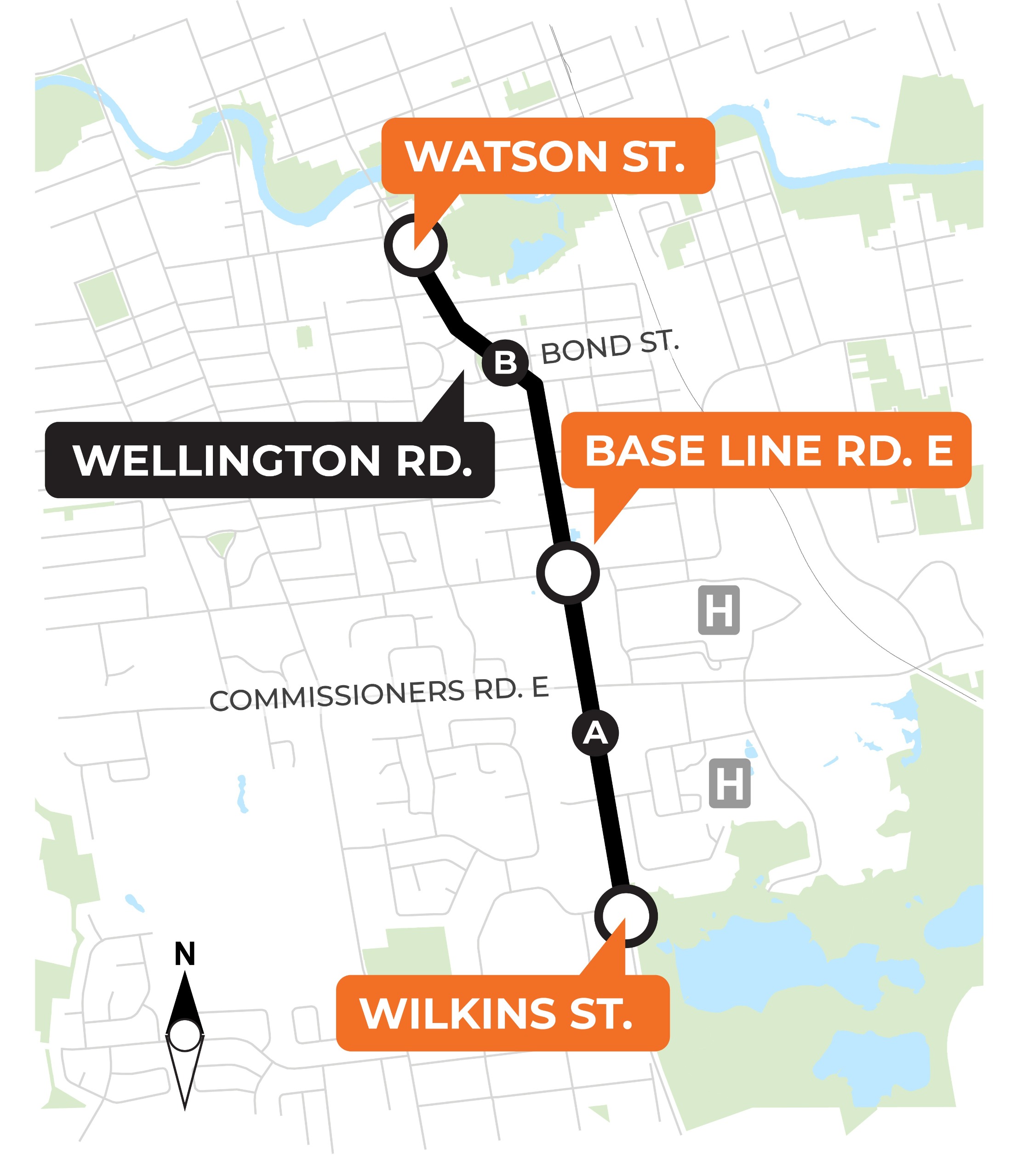
Above: Map showing Wellington Gateway Phase 2 construction, including staging plans along Wellington Road 2A (Wilkins Street to Baseline Road East) and Wellington Road 2B (Baseline Road East to Watson Road).
Construction is ongoing along Wellington Road through 2025, from Wilkins Street to just north of Exeter Road.
Project Limits
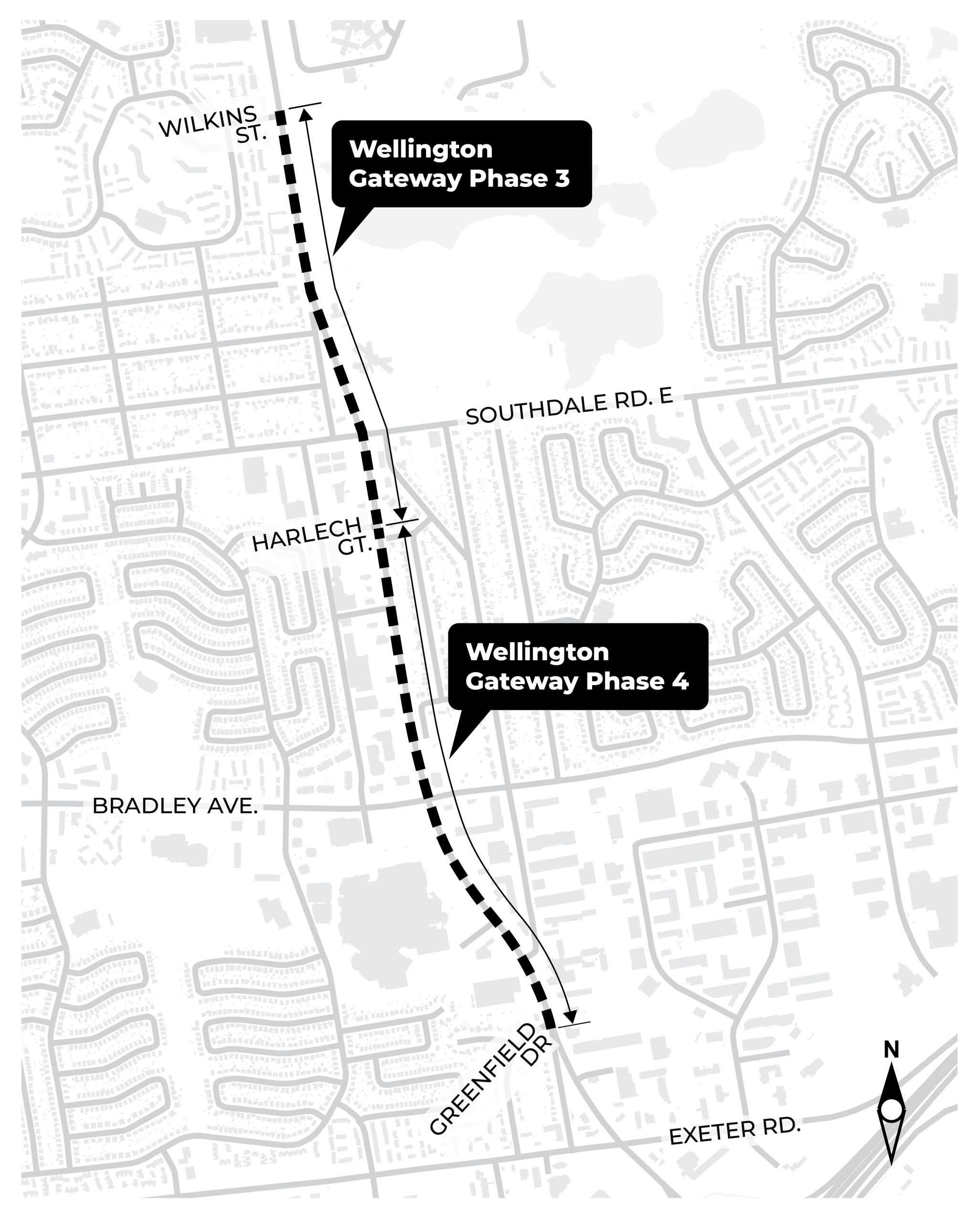
- Phase 3: Wellington Road from Wilkins Street to Harlech Gate
- Phase 4: Wellington Road from Harlech Gate to Wellington Commons entrance

Above: Conceptual rendering of Wellington Gateway Phase 4 at White Oaks Mall
Design webinar
A virtual meeting was hosted on February 14, 2024, presenting the project design, anticipated construction timeline, and impact mitigation measures. Watch the webinar here.
In 2024 we began to widen Clark’s Bridge, which you may know as “Wellington Bridge” and crosses the Thames River between Grand Avenue and South Street. The bridge is being widened to accommodate two traffic lanes, two new transit-only lanes, and a multi-use path for cyclists and pedestrians
The Clarks Bridge is 46 years old and these improvements will address its current needs, while extending the bridge life by another 50 years before it has to be replaced.
In 2026 will we begin finishing works such as surface asphalt, painting the red bus lanes, permanent pavement markings and landscaping.

Above: Aerial view of Clarks Bridge construction progress as of November 2025.
Pre-construction Webinar
A virtual meeting was held on Wednesday, March 27, 2024, detailing what to expect during construction.
Watch the webinar.
Construction schedule and staging
Construction on Clark’s Bridge is being completed in stages to maintain road access and connections to the TVP.
- Stage 1 work began on the east side of the bridge, with lane restrictions in place throughout the construction area.
- This stage also includes improvements at the Watson Park parking lot on Front Street and along Grand Avenue East.
- Winter work may proceed, weather permitting, to keep the project moving forward.
- Stage 2 and remaining stages will begin in 2025 to complete the bridge rehabilitation and road reconstruction.
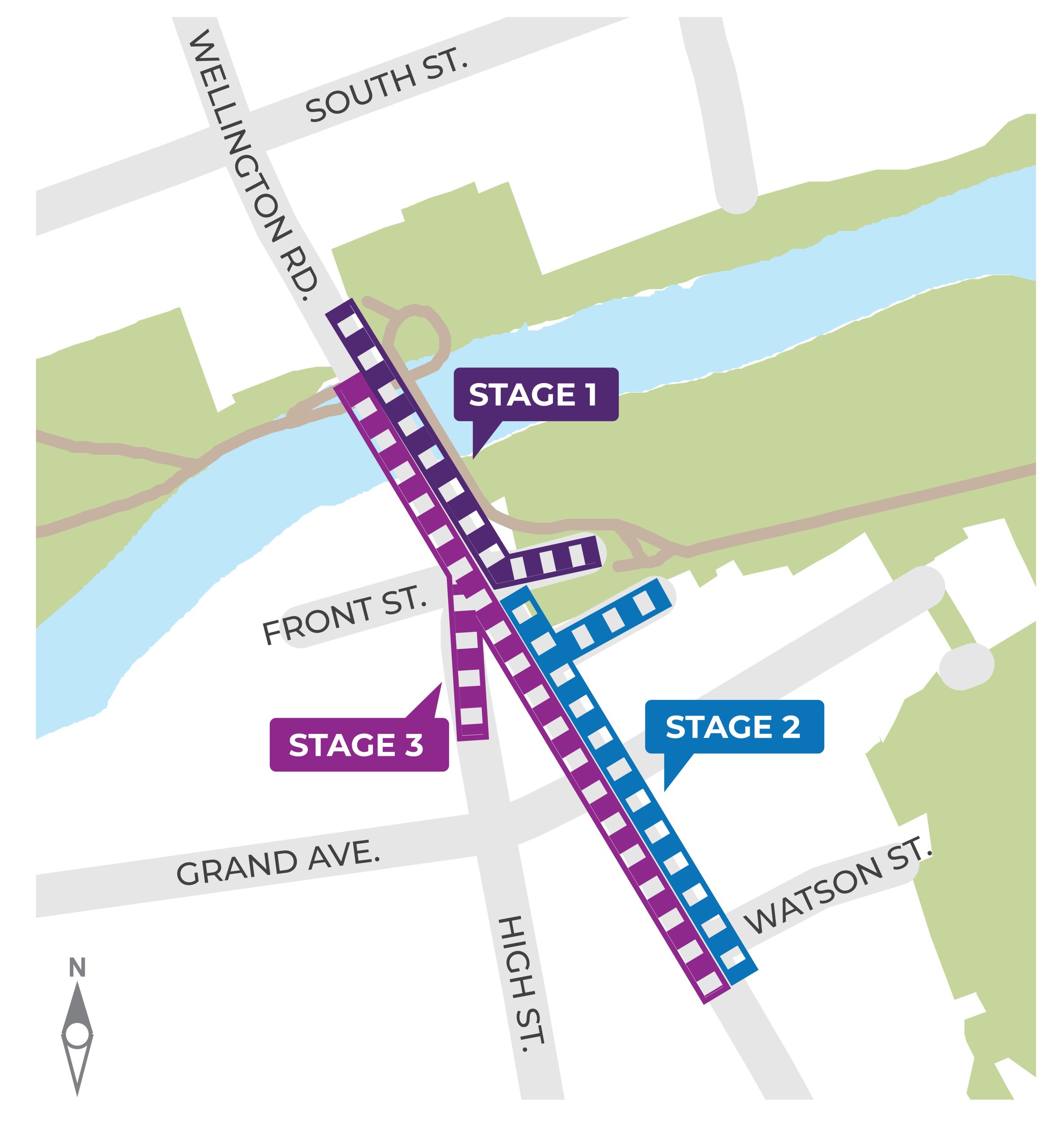
Above: Clark's Bride construction phasing.
Traffic Impacts
Lane restrictions are in place for both northbound and southbound travel for the duration of the project. Left turns are limited to signalized intersections, and drivers should expect delays through this section of Wellington Road.
All local businesses remain open and accessible during construction.
Access to the Thames Valley Parkway (TVP)
The TVP will be closed in this area during construction to allow bridge work to be completed safely and efficiently. A signed detour is provided to help people walking and biking navigate around the closure and reconnect with the TVP north of the bridge.
Most major construction for Phase 1 of the Wellington Gateway project was completed in 2023, with final paving and finishing work completed in 2024.
This section now includes centre-running, bus-only lanes and new rapid transit stops at Horton Street and South Street. Upgrades also include renewed sanitary and storm sewers, new traffic signals, and improved landscaping and urban design.
Work north of York Street was delivered as part of the Downtown Loop Phase 3 project, which is now complete.
You may have noticed the red bus lanes downtown and wondered if Rapid Transit is already in service. Buses are currently using these lanes; however, full Rapid Transit service will launch in stages as the remaining corridors, stations, and systems are completed over the next few years.
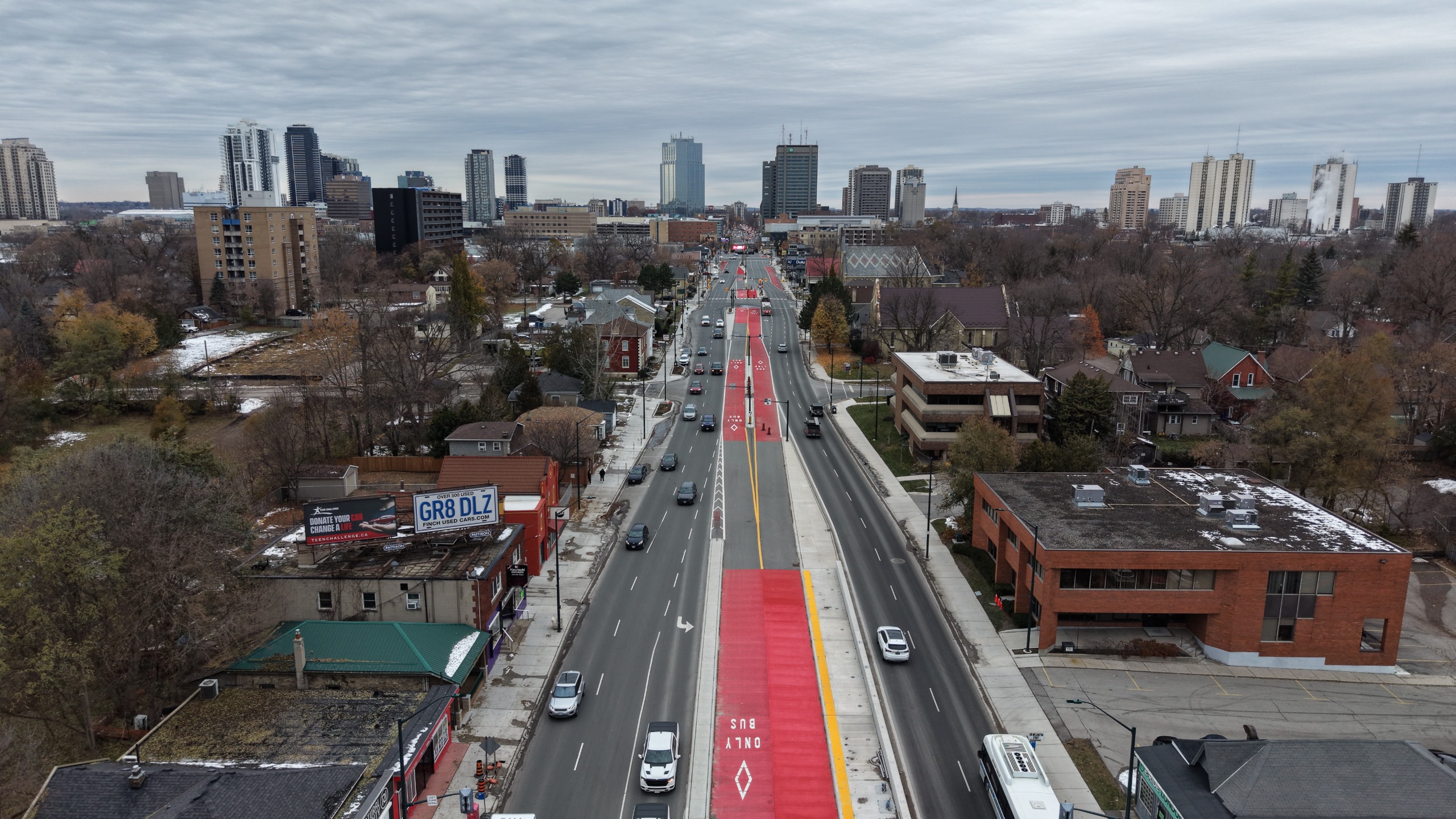
Above: A photo showing Wellington Gateway Phase 1 facing north from the Thames River