
‘Clean’ vs ‘Dirty’ organics
4 January 2021
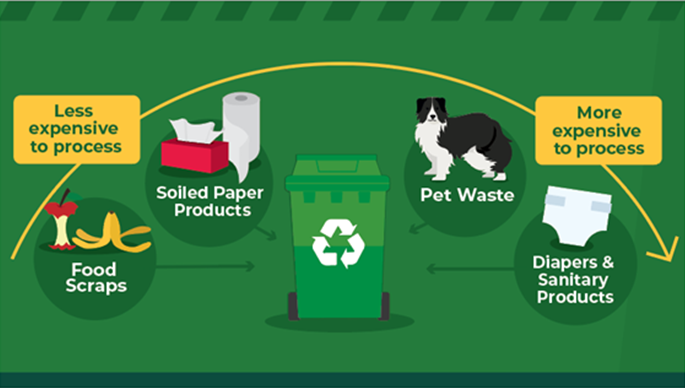
A decision about the types of materials permitted in the Green Bin is the most critical decision because it will impact other significant operational decisions. Food waste and non-recyclable and soiled paper are the most common materials collected in Green Bin programs. Some Ontario Green Bin programs also accept pet waste and diapers/sanitary products. Yard waste in varying quantities may also be accepted.
The terms ‘clean’ and ‘dirty’ can be used to describe Green Bin program material streams, where ‘clean’ describes programs that permit food waste, soiled paper products and some yard waste, and ‘dirty’ describes those that also accept pet waste and diapers/sanitary products.
What do you want for London?
There are a number of different items that could be included in London's Green Bin program. These potential items include:
- Food waste
- Soiled paper
- Cooking oils and grease
- Household plants
- Pet waste
- Diapers, sanitary products
- Yard waste
Background information
Food waste represents about 60% of Green Bin materials and about two thirds of this is avoidable food waste. ‘Avoidable’ means the food could have been eaten. Consider what steps could be taken in your household to reduce avoidable food waste.
Approximately 50% of London homes have pet waste. Pet waste is approximately 50% dog waste (feces) and 50% cat litter and waste (feces). Including pet waste in the Green Bin will increase processing costs and make the Green Bin materials more difficult to process. It will increase diversion through the Green Bin by between 10% and 20%.
Approximately 10% of homes in London have diapers/incontinence products.
Including pet waste and diapers/sanitary products could increase processing costs by between 20% and 40%. Diversion through the Green Bin could increase by between 15% and 25%. It is important to note that the diaper/sanitary products are not composted or digested; therefore, they still end up in the landfill. Depending on the type of pre-processing system used, many dog waste bags may not open and not expose the contents for further processing.
As noted, both products make the Green Bin materials more difficult to process. However, including these materials in the Green Bin will:
- make it easier for the public to accept bi-weekly garbage collection;
- provide minor landfill cost savings; and
- further reduce greenhouse gas emissions.
Currently, at least four processing facilities in the Province (one composting facility and three anaerobic digesters) have available capacity to accept organics from London. All four can accept pet waste and diapers/sanitary products. Generally, composting facilities are better suited than anaerobic digesters to manage pet waste and anaerobic digesters are better suited than composting facilities to manage diapers/sanitary products.
It is expected that new organic management facilities in the future are more likely to be anaerobic digesters and not composting facilities.
London will also need to decide if a portion of yard waste will be accepted in the Green Bin.
What about other municipalities?
A review of 15 Ontario Green Bin programs and three other Canadian programs found that all municipalities have a material mix that includes food, soiled paper, cooking oils and grease and household plants. In addition to this, one-half of municipalities allow pet waste. Only two municipalities allow diapers and incontinence products. See the table below for the details.
Two municipalities – City of Toronto and Hamilton – are highlighted below as representing two diverse programs in terms of the materials permitted in the Green Bin.
Toronto
Toronto allows diapers and sanitary products, pet waste and non-degradable plastic bags in the Green Bin.
Learn more about Toronto’s Green Bin program
View a poster about what goes in Toronto's Green Bin
Hamilton
Hamilton does not allow diapers or pet waste and has recently banned yard waste from their program.
Learn more about Hamilton's Green Bin program
Municipality |
Food waste, soiled paper, cooking oils & grease, Household plants |
Pet waste |
Diapers, sanitary products |
Yard waste |
City of Toronto |
P |
P |
P |
|
Region of York |
P |
P |
P |
|
City of Guelph |
P |
P |
||
Region of Niagara |
P |
P |
||
City of Ottawa |
P |
P |
P |
|
Simcoe County |
P |
P |
||
City of St Thomas |
P |
P |
P |
|
Region of Waterloo |
P |
P |
||
City of Barrie |
P |
|||
Dufferin County |
P |
|||
Region of Durham |
P |
|||
City of Hamilton |
P |
|||
Region of Halton |
P |
|||
City of Kingston |
P |
P |
||
Region of Peel |
P |
|||
City of Vancouver |
P |
|
|
P |
City of Calgary |
P |
P |
|
P |
City of Halifax |
P |
|
|
P |