
Bi-weekly garbage collection: What concerns do you have?
4 January 2021
|
During the development of the 60% Waste Diversion Action Plan, it was identified that a switch to bi-weekly, same-day garbage collection and weekly recycling and Green Bin collection (on the same day) would be less costly than weekly garbage pickup. Bi-weekly garbage pickup was also considered as key to higher use of the Green Bin program. What will be the impact of bi-weekly garbage collection for you?
Diapers and sanitary productsIf these items are not permitted in the Green Bin storing them for a two-week period may be the hardest challenge of the bi-weekly schedule, and especially when storage in a garage or outdoor shed is not an option. Collecting these items in the Green Bin is advantageous for the convenience it provides, however there are disadvantages as well. Is it important for you that these items are collected in the Green Bin? Learn more about what items can go in the Green Bin. If these items are not collected in the Green Bin, there are other options that can be considered to help households manage them over longer collection cycles. These options will be reviewed as part of London’s Green Bin implementation. Table 1 below lists some options that have been used in other Ontario municipalities.
Smelly food waste Currently food waste is collected with garbage on a six-day collection schedule. When Green Bin collection begins, food waste (in the Green Bin) will be collected more frequently than it is currently. A weekly collection of Green Bin will be an encouragement for households to ensure food waste goes into the Green Bin and not the garbage bin. A challenge for handling food waste in the Green Bin, compared to the garbage may depend on what bin liners are permitted. For example, food waste in a plastic garbage bag is easier to store for a longer time than food waste stored in a paper or compostable bag. However, introducing plastic in the Green Bin creates other challenges. Keep in mind that there are non-liner solutions that households can use.
Pet waste If pet waste is not permitted in the Green Bin, storing it for a two-week period will be more of a challenge. Some households have found that dog waste is easily managed using a backyard digester (sold by the City of London at EnviroDepots). However, digesters cannot manage kitty litter.
Larger volume of garbage created over a two-week period Less frequent garbage collection means that more garbage will accumulate, and households will have to store it for a longer period. Making full use of the City’s waste diversion programs could make a significant reduction in the amount of waste needing to be stored. For example, using the Green Bin for all food waste will reduce the quantity of wet and smelly garbage that needs to be held for up to two weeks. And some households could improve their recycling efforts; waste audits show that some households continue to place Blue Box and other recyclables (e.g., electronics, scrap metal, batteries, etc.) in the garbage. The City will provide reminder information about the recycling programs that are available to help ensure that these materials are not being put in the garbage. Garbage tags for curbside pickup and EnviroDepot drop off will continue to be available for households that have garbage above the collection limit or who want to discard of it prior to collection using one of the EnviroDepots. There is a cost for tags and EnviroDepot drop-off.
Missing a pickup If you are away and miss a pickup this means going four weeks between garbage collections. Like all new programs there will be an adjustment phase that includes changing behaviour to adjust to the change. Adjustments could include relying on a neighbour or using the EnviroDepot drop-off.
What about other municipalities? Municipalities with Green Bin programs have found that the amount of organic material collected increases by 50% to 100% with the introduction of bi-weekly garbage collection. Collection of Blue Box recyclables also increases with the introduction of bi-weekly garbage collection. Twelve of the fifteen largest Ontario municipalities with a Green Bin program have bi-weekly garbage collection (Table 2), and two of the other programs are reviewing the option or in transition to go to bi-weekly collection.
Notes: 1 Reviewing bi-weekly garbage collection 2 Weekly garbage, bi-weekly green bin and recycling 3 Changed to bi-weekly garbage collection in October 2020 4 Changed to bi-weekly garbage collection in February 2020
Diapers and sanitary products Bi-weekly collection of garbage is a challenge for households that use diapers, and sanitary products. Some municipalities have introduced programs to assist households to manage these materials over the bi-weekly collection cycle. These programs are summarized in Table 1 above. | |||||||||||||||||||||||||
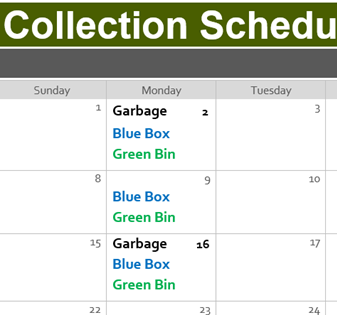 Managing garbage over a two-week period will vary for each household, with potentially a greater impact on large households and those using diapers, and sanitary products. Below are some factors to consider.